Free Shipping worldwide on order above $100
Join our empowerment journey for artisan stories, new arrivals, and exclusive offers.
Hand-knitted wool socks and leg warmers in pure Himalayan sheep wool, made stitch by stitch by artisans in our own workshop in Pokhara, Nepal. Two different answers to the same problem: ankle socks for feet that go cold inside shoes and inside houses, and ribbed leg warmers for calves and ankles that nothing else covers properly. Every pair is knitted by hand from fleece bought directly from shepherds in the Nepali hills, then washed, sorted, and spun in the same workshop before anyone picks up a needle. Both are unisex, both one size, and both made the slow way rather than run off a machine.
Most people who say their feet are always cold are wearing perfectly adequate socks. The socks are not the failure. Circulation is.
Your feet and lower legs are the furthest point from your heart, which means they are the last place warm blood reaches and the first place your body gives up on when it decides to protect your core instead. Sit still at a desk for two hours and blood flow to your feet drops. The room has not gotten colder. You have stopped sending heat down there.
Insulating the foot itself, so the small amount of heat that does arrive stays put instead of leaving through the sole.
Keeping the calf and ankle warm, because that is where blood travels through on the way down, and warm blood arriving beats cold blood arriving.
That is the honest reason this page holds two products rather than one. The socks handle the first. The leg warmers handle the second. People who have cold feet all winter usually need both, and almost nobody tells them that, because almost nobody sells both.
One hundred and thirty grams of hand-knitted Himalayan wool, cut to sit at the ankle, in green and dark red. Rated 4.56 across 9 reviews, which is more feedback than any other wool piece we make.
Ankle length is a deliberate choice rather than a shortcut. It keeps the wool where it does the work, around the foot and the ankle bone, without adding bulk up the calf where a boot or a trouser leg is already doing that job. It also means they go into ordinary shoes rather than only into boots.
It traps more air per gram, because a person knits looser than a machine at the same yarn weight.
It keeps insulating when damp, which matters in a shoe, where feet sweat whether it is cold or not.
It resists odour, so a pair can go several days between washes without becoming unpleasant.
That last point is the reason wool has stayed the standard for hiking socks despite decades of synthetic alternatives. Cotton socks get damp and go cold and stay cold. Wool socks get damp and carry on working.
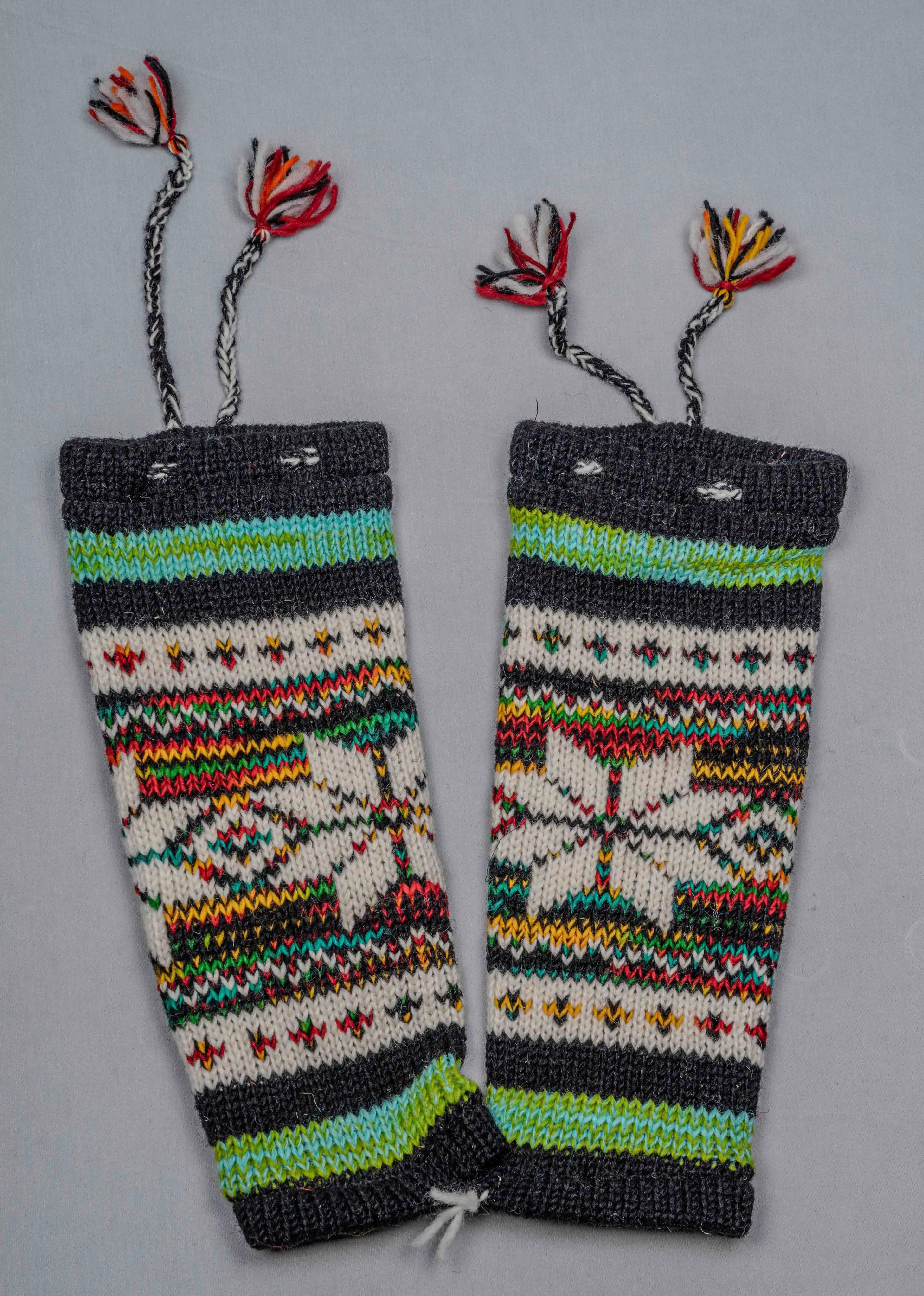
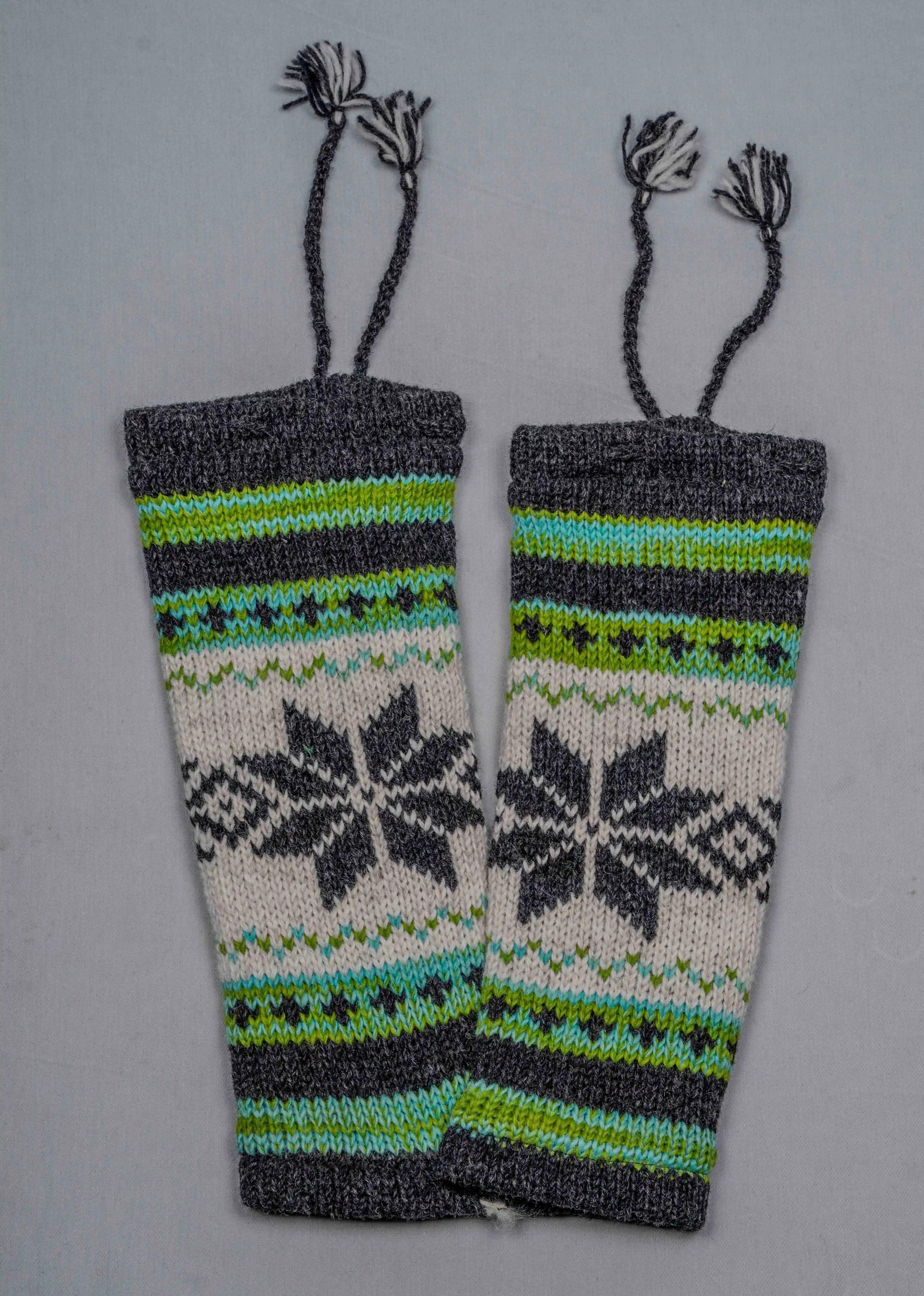
Two hundred and fifty grams, classic ribbed, stretchable, one size. Rated 4.71 across 7 reviews, the highest score of anything in our wool range.
At 250 grams, these are the most substantial thing we knit, heavier than the beanie and nearly twice the weight of the socks. That is the point of them. A leg warmer is not a decorative tube; it is insulation for the part of your leg that trousers cover thinly and boots do not reach.
The rib is what makes one size honest. Vertical channels open and close under tension, so the same pair sits properly on a slim calf and a broader one without gripping either. The rib also recovers, so pulling them on and off daily through a winter does not leave them slack at the top.
Over leggings or trousers, for walking, standing outdoors, or a cold commute.
Under a long skirt or wide trousers, where nobody sees them, and they do all the work.
Around the house, pulled on over whatever you are already wearing, which is the most common use by a distance.
Both pairs are one size and unisex, and are hand-knitted ribbed socks that are a real answer rather than a way of dodging the work. The rib stretches to the foot and closes back down, so the same pair sits properly across the ordinary adult range instead of fitting one size and leaving everyone else to compromise.
What differs is what people reach for and why, and it is worth saying plainly so you can pick faster.
Men mostly buy the ankle socks at $20. The ankle cut is the reason: it puts wool around the foot and ankle without bulking up the calf, so they go into work boots, walking boots, and ordinary shoes without changing how anything fits. Bought most often for cold offices, winter commutes, and trekking.
Women buy both, and the leg warmers at $20 are bought overwhelmingly by women. Worn over leggings, under long skirts and wide trousers, or simply pulled on at home over whatever is already on. They are also the piece bought most often for someone else.
Neither is made in a men's or a women's version, because a ribbed sock does not need one. The green and dark red colourway on the socks is the only thing that reads either way, and it reads as handmade rather than as one or the other.
Socks are the only thing on this site worn directly against skin, inside a shoe, for twelve hours at a stretch. That deserves a straighter answer than a jacket does.
Himalayan wool is not the finest fibre in the world. Merino is finer, and if you want the softest possible sock, merino is the honest recommendation. What Himalayan wool gives you instead is a coarser, springier fibre that resists abrasion far better, and abrasion is what actually kills socks. They wear out at the heel and the ball of the foot, which is exactly where a fine fibre gives up first.
On comfort, straight answers:
Most people do not find these itchy on the foot. The foot is far less sensitive than the neck.
The ankle edge is where you would notice it, if you notice it anywhere.
They are not chemically stripped or superwash coated, so the wool keeps its natural softness rather than being processed into it.
If you know you react to wool on skin, this is the one product on the page where that matters, and no amount of copy changes it. Exchanges are free, so the cost of finding out is a return postage label rather than a pair of socks you will not wear.